🇬🇧 Trending in your area POPULAR

There's Something On Your MRI That Your Surgeon Never Looked For. And It's The Real Reason Your Sciatica Keeps Coming Back.

It's not "just a trapped nerve". It's not "just your discs". It's not your age. Scientists now know there's a hidden part of your spine that holds everything in place — and every treatment you've tried has completely ignored it.

Man woken at 3AM by pain shooting down his leg

You know the feeling by now.

That electric jolt that starts in your lower back, shoots through your buttock and runs down the back of your leg.

Twenty minutes in the car, at your desk or on the sofa, and it starts burning.

You stand up slowly, holding the arm of the chair, waiting for your leg to "wake up" before you dare take a step.

Some nights it wakes you at 3AM, and there's no position that makes it stop.

You've stopped making plans. You've stopped saying yes to things. Long drives, cinema trips, a meal out — anything that means sitting still for too long.

Maybe you've tried physio.

Chiropractors. Stretching routines, a special cushion for the car, hot water bottles, a TENS machine from Amazon.

And yet here you are.

You're doing everything right. And nothing seems to last.

Here's what nobody has told you yet:

It's not because your back is beyond help. It's because almost everything you've tried has been focused on the wrong thing.

Sound Familiar?

  • Pain that shoots from your lower back, through your buttock and down one leg
  • Burning, tingling or pins and needles in your calf or foot
  • Sitting for more than twenty minutes makes it flare
  • You have to "wake up" your leg before you can walk after sitting
  • Coughing, sneezing or bending to tie your shoes sends a jolt down your leg
  • You wake up at 3AM and can't find a position that doesn't hurt
  • You've tried everything, and the pain always comes right back

If even one of those hit home, keep reading.

Because what you're experiencing has a specific explanation.

And it's one almost nobody talks about.

Why Everything Has Failed You

Painkillers, injections and an old TENS machine

Let's be direct about what most of these approaches actually do, and why the results don't stick.

Stretching and hot water bottles loosen the surface for an hour or two. But they don't open up the space between your vertebrae, and they don't reach the deep muscles that are supposed to hold you up. By lunchtime, the burning in your leg is back.

Chiropractic visits feel great for a few hours. But without that deep muscle doing its job, nothing keeps your spine steady between appointments — at £60 a time.

Massage chairs and massage guns knead the top layer of muscle. It feels wonderful while it lasts. Then you sit down for twenty minutes and the shooting pain is back.

Special cushions and lumbar supports promised to "take the pressure off." They change how you sit — but they can't create a single millimetre of space around the nerve.

A new mattress, a £300 pillow, a different chair. You've rearranged your whole house around your back. But you can't sleep, sit or stand your way to a stronger deep muscle.

TENS machines buzz the skin. They make the surface tingle for a while — but they don't decompress anything, and they don't warm or loosen the muscle underneath. Most end up in a drawer after a week.

Do you see the pattern? Everything works on the surface.

Not one of them reaches the deep support muscle underneath.

The Deep Muscle That Holds You Up

Your spine isn't just a stack of bones.

It's held steady by a deep stabilising muscle that runs right alongside each vertebra, closer to your spine than almost any other muscle in your body.

When this muscle is working, it acts as your spine's internal brace.

It keeps the space between your vertebrae open — and that's the space your sciatic nerve passes through on its way down to your leg.

When that space closes up, the nerve gets pinched. That's the shooting pain, the burning in your buttock, the pins and needles in your foot. And it's why sitting makes it worse: every minute in a chair presses those vertebrae closer together.

After years of long days, sitting, bending and lifting, this muscle works harder than almost any other muscle you have.

But here's the frustrating part: it rarely gets any direct attention.

Not with rest. Not with stretching. Not with hot water bottles or massage.

They all work the surface.

So you can do everything right, and the muscle doing the most to protect that nerve is still the one nothing ever reaches.

So the most important question is one almost nobody asks: what are you doing for the deep muscle that holds you up?

The Muscle Nobody Told You About

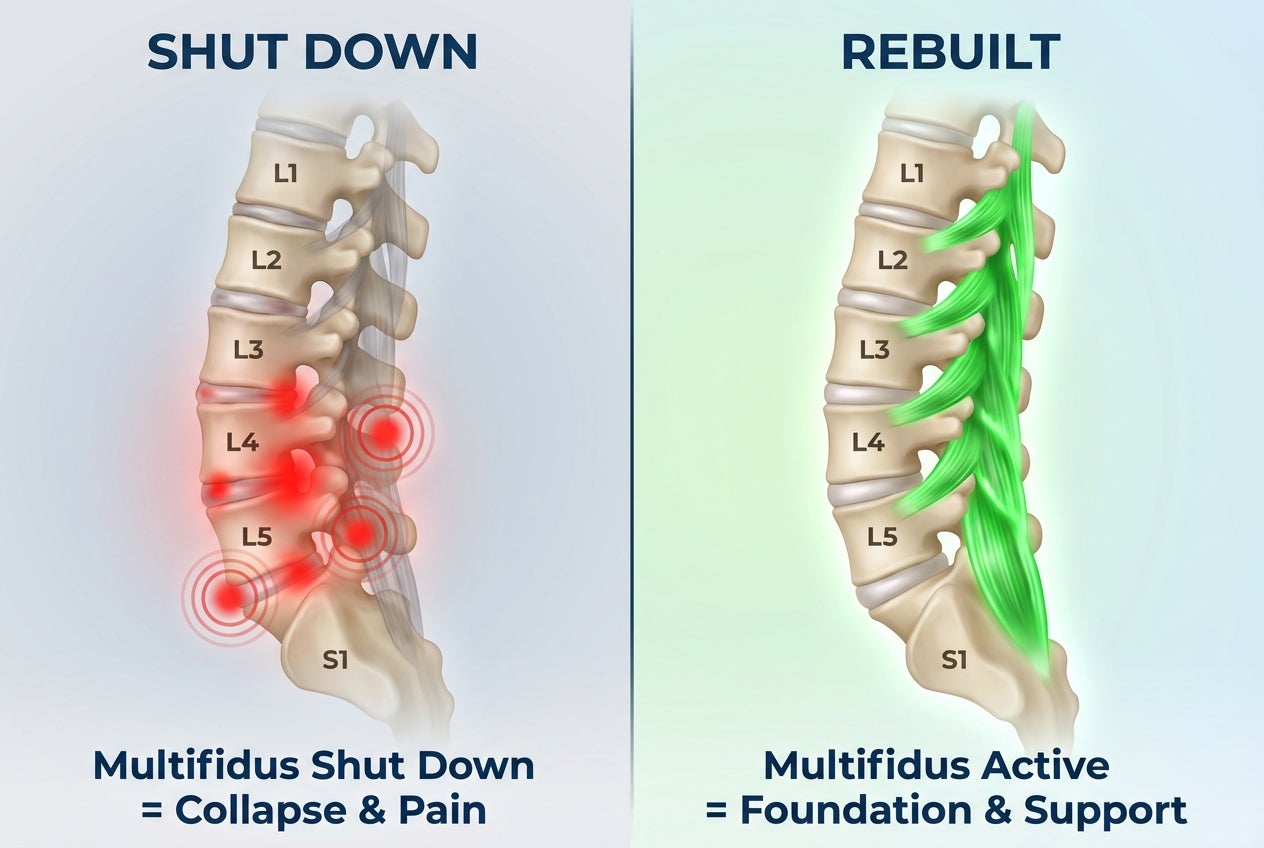
Multifidus shut down versus multifidus active

It's called the multifidus.

You've probably never heard of it. Most people haven't.

But it's one of the most important stabilisers in your lower back — running along both sides of your spine, right where the sciatic nerve begins its journey down to your leg.

And it shows up on your MRI. In people with long-term back and leg pain, scans often show this muscle wasted and marbled with fat. It's right there on the images. But almost nobody reads that part of the scan — they look at the bones and the discs, tell you it's "a trapped nerve", and send you home.

When the multifidus gets tired and weak, the space between your vertebrae closes up, the discs dry out and flatten, and the nerve has less and less room.

And it's a vicious circle: a compressed, dried-out spine is exactly the spine this muscle can't hold. Like trying to put up a tent with the poles jammed together.

Now everything makes sense:

Why stretching only helps for an hour: It loosens the surface, but never reaches the deep muscle underneath.

Why hot water bottles feel good, then fade: The warmth stays on the surface. The space around the nerve stays closed.

Why that TENS machine ended up in the drawer: Buzzing the skin doesn't decompress anything.

But what if you could reach both — the space and the muscle — from your own sofa, in just 15 minutes a day?

The Breakthrough: Waking Up Your Foundation

For years, spine clinics have used three separate treatments to take the pressure off a pinched nerve: decompression tables to open up the space between the vertebrae, deep heat to bring fluid and nutrients back into the discs, and deep-tissue work along the muscles beside the spine.

But each one is a separate appointment, often £80 or more a session, and almost nobody gets all three together.

That's why our team created Orevive SpineEase™, an at-home device designed to do all three in one session, while you lie on your sofa or bed — including working along the multifidus on both sides of your spine.

Phase 1: Decompress & Release. A gentle air cushion lifts and stretches your lower back, opening the space between your vertebrae by 3–7 mm and taking the pressure off the nerve. Users describe an immediate feeling of lightness in the lower back.

Phase 2: Rehydrate & Relax. Soothing heat at around 50°C reaches 7–8 cm deep, helping fluid and nutrients flow back into tired discs and letting the overworked surface muscles finally let go.

Phase 3: Reset & Rebuild. Targeted massage nodes work along both sides of your spine — right where the multifidus runs — releasing years of protective tension and waking the deep muscle up so it can hold the space you've just created.

What To Expect: The 30-Day Foundation Rebuild

First 15 minutes: A gentle lift and stretch, then warmth spreading deep into your lower back, then a rhythmic kneading along both sides of your spine. Most users describe an immediate feeling of lightness.

Week 1: The jolts down your leg start to come less often. Sleep improves because you're not woken by the burning every time you roll over.

Weeks 2–4: Sitting through a film or a long drive gets easier. Your leg "wakes up" faster when you stand. Tying your shoes stops being something you brace for.

Week 4+: Your deep core is back in the game. Many users move to 2–3 sessions per week to keep their foundation strong.

Orevive SpineEase customer reviews — 4.8 out of 5

Why SpineEase Is Different From Everything You've Tried

Orevive SpineEase — designed to help relieve sciatica, trapped nerves and lower back pain
  • ✅ Opens the space around the nerve — gentle decompression lifts the vertebrae apart, so the sciatic nerve isn't being pinched.
  • ✅ Targets the multifidus — massage nodes work the deep muscles along both sides of your spine, not just the surface.
  • ✅ Lie down, press one button — 15 minutes a day on the sofa or in bed. No clinic visits, no complicated setup.
  • ✅ Drug-free and non-invasive — no prescription, no needles, no waiting list.
  • ✅ 90-day money-back guarantee — you either feel the difference or you get every penny back.

TODAY: Get 60% OFF the Orevive SpineEase™ Triple Fusion System

Orevive SpineEase with carry bag and 90-day money-back guarantee

Stop Treating The Pain. Start Rebuilding The Foundation.

You've done the stretches. Tried the hot water bottles and the cushions. Tried the gadgets.

And the jolts down your leg keep coming back.

Not because your back is beyond help — but because nothing you tried opened up the space around the nerve, or reached the deep muscle that's supposed to keep it open.

SpineEase was built to do both.

Plus 3 Free Gifts:

  • 🎁 Free access to the Orevive+ App: Sciatica Exercise Videos, to help you stay consistent
  • 🎁 The Orevive carry bag — SpineEase folds away so you can take it to work, on holiday or to a relative's
  • 🎁 FREE UK delivery, dispatched the same day when you order before 3pm

The 90-Day Promise: If you're not happy with SpineEase after 90 days, send it back for a full refund. You have nothing to lose.

Stock is limited due to high demand — click below to check availability and claim your discount:

IMPORTANT INFORMATION

Orevive is offering a unique deal to our readers. You can order SpineEase™ now with 60% off, and UK delivery is FREE.

Where can I get Orevive SpineEase™? You can find it directly on the official website by clicking here.

PS: Orevive SpineEase™ is also protected by a 90-day money-back guarantee. Simply send an email and you'll get your money back.

Comments

James Whitaker 11 hours ago

I've had sciatica on and off for a few years. Even after physio, sitting through a drive was a struggle. I gave SpineEase a try about six weeks ago and the pain down my leg has eased a fair bit. I've started taking my dog on short morning walks again. It's become part of my evening routine.

👍 38 likes · Comment

Emily Carter 1 day ago

A friend sent me this article and I was sceptical because I'd already tried so many things. After about six weeks, my lower back feels more stable and the tingling in my foot has calmed down. I still have some bad days, but overall I'm happy with how it's going.

👍 15 likes · Comment

Sarah Mitchell 1 day ago

I couldn't sit through a film without the burning down my right leg. Driving to my daughter's was an hour of agony. Four weeks with SpineEase and I'm sleeping through the night, and I managed the drive last weekend without stopping once. That alone is worth everything.

👍 21 likes · Comment

Daniel Thompson 2 days ago

Anyone who has used an old TENS machine knows it just buzzes your skin. This one lifts, warms and works the muscles all in one go, and I use it every evening after work. I just lie back on the sofa and press the button.

👍 31 likes · Comment

Finally Get Your Back Working For You Again

Recommended:

4.8 star rating

4.8 | 3,791 Reviews

Orevive SpineEase with carry bag

orevive

BLACK FRIDAY SALE: Get 60% Off + Free UK Delivery!

Check Availability

Results may vary from person to person. This content is provided for informational and advertising purposes only and should not be considered medical advice. It is not intended to diagnose, treat, cure, or prevent any disease or medical condition. Always consult a qualified healthcare professional regarding any medical condition or before making changes to your healthcare routine.

Terms of Service | Privacy Policy | Contact